Primary Sources

Legal & Government Records

Court records, bar applications, legislative acts, government correspondence, and official certificates documenting Myra Bradwell's legal career and constitutional legacy.

Court Records

Document image for Application for Admission to the Illinois Bar

Application for Admission to the Illinois Bar

Date: August 2, 1869

Repository: Illinois State Archives, Springfield, Illinois

Bradwell's formal application for admission to the Illinois bar, submitted with a certificate of good moral character and evidence of legal study. The Illinois Supreme Court acknowledged her credentials as facially sufficient but declined to grant the license on the ground that her status as a married woman precluded her from entering into the contracts incident to legal practice. This document is the originating instrument of the litigation that culminated in Bradwell v. Illinois.

Document image for Petition for Rehearing, Illinois Supreme Court

Petition for Rehearing, Illinois Supreme Court

Date: 1869

Repository: Illinois State Archives, Springfield, Illinois

Bradwell's petition to the Illinois Supreme Court for reconsideration of its denial of her bar application. The petition advanced the argument that the right to pursue a lawful occupation was among the privileges and immunities of national citizenship protected by the Fourteenth Amendment — an argument she would press before the United States Supreme Court four years later. The court again declined, holding the matter one for legislative rather than judicial resolution.

Document image for Bradwell v. Illinois, 83 U.S. 130 — Writ of Error

Bradwell v. Illinois, 83 U.S. 130 — Writ of Error

Date: 1871

Repository: National Archives and Records Administration, Washington, D.C.

The writ of error by which Bradwell brought her case before the United States Supreme Court, challenging the Illinois Supreme Court's denial of her bar application as a violation of the Fourteenth Amendment's Privileges or Immunities Clause. The writ initiated the first Supreme Court proceeding to address the application of the Fourteenth Amendment to a claim of occupational liberty asserted by a woman.

Document image for Bradwell v. Illinois, 83 U.S. 130 — Brief of Plaintiff in Error

Bradwell v. Illinois, 83 U.S. 130 — Brief of Plaintiff in Error

Date: 1872

Repository: National Archives and Records Administration, Washington, D.C.

The merits brief filed on Bradwell's behalf, prepared with the assistance of Senator Matthew Carpenter of Wisconsin. The brief argued that the right to pursue any lawful employment was a privilege of national citizenship that the Fourteenth Amendment protected against state abridgment. The argument drew on antebellum free labor ideology and the legislative history of the Amendment, and anticipated constitutional arguments that would not be vindicated by the Court for nearly a century.

Document image for Bradwell v. Illinois, 83 U.S. 130 — Supreme Court Opinion

Bradwell v. Illinois, 83 U.S. 130 — Supreme Court Opinion

Date: April 15, 1873

Repository: National Archives and Records Administration, Washington, D.C.; published at 83 U.S. (16 Wall.) 130

The Supreme Court's decision affirming the Illinois Supreme Court's denial of Bradwell's bar application. The majority opinion, authored by Justice Samuel Miller, held on narrow grounds that the privileges and immunities of national citizenship did not include the right to practice law in state courts. Justice Joseph P. Bradley's concurrence, joined by Justices Swayne and Field, went further, invoking natural law and the doctrine of separate spheres to justify the exclusion of women from the legal profession.

Document image for Order of Admission, Illinois Supreme Court

Order of Admission, Illinois Supreme Court

Date: March 1890

Repository: Illinois State Archives, Springfield, Illinois

The Illinois Supreme Court's order admitting Myra Bradwell to the bar on its own motion, twenty-one years after her original application. The court acted without requiring a new application, acknowledging implicitly that the grounds on which it had previously denied her admission were no longer tenable following the Illinois legislature's 1872 amendment permitting women to practice law. Bradwell received the order but did not enter active courtroom practice.

Document image for Certificate of Admission, United States Supreme Court Bar

Certificate of Admission, United States Supreme Court Bar

Date: 1892

Repository: National Archives and Records Administration, Washington, D.C.

The certificate admitting Myra Bradwell to practice before the United States Supreme Court, issued two years before her death. The admission was largely ceremonial by this point — Bradwell had long since devoted her energies entirely to the Chicago Legal News and to legislative reform — but it carried symbolic weight as a formal acknowledgment by the court that had ruled against her nineteen years earlier.

Legislation

Document image for Illinois Married Women's Property Act

Illinois Married Women's Property Act

Date: 1861

Repository: Illinois State Archives, Springfield, Illinois; Laws of Illinois, 22nd General Assembly

Illinois legislation granting married women the right to hold, manage, and convey property in their own names, free from their husbands' control. Bradwell was among the advocates who lobbied for the act's passage, working alongside other Illinois reformers to dismantle the common law doctrine of coverture that had rendered married women legally invisible. The act predated her bar application by nearly a decade and illustrated the breadth of her legal reform agenda.

Document image for An Act to Permit Females to Practice Law

An Act to Permit Females to Practice Law

Date: March 22, 1872

Repository: Illinois State Archives, Springfield, Illinois; Laws of Illinois, 27th General Assembly

Illinois legislation amending the state's bar admission statutes to permit women to practice law. The act was passed in direct response to the Illinois Supreme Court's denial of Bradwell's application and to the advocacy she conducted through the pages of the Chicago Legal News. Its passage rendered the constitutional question she had pressed before the United States Supreme Court moot as a matter of Illinois law, though the federal constitutional issue remained unresolved.

Document image for Chicago Legal News Company Charter

Chicago Legal News Company Charter

Date: 1868

Repository: Illinois State Archives, Springfield, Illinois

The special legislative charter incorporating the Chicago Legal News Company, obtained by Bradwell from the Illinois General Assembly. The charter was unusual in that it vested management authority in Myra Bradwell personally, notwithstanding her status as a married woman — a deliberate drafting choice that insulated the company from the legal disabilities of coverture and allowed her to enter into contracts, employ staff, and conduct business in her own name.

Document image for Act Designating the Chicago Legal News as Official Repository

Act Designating the Chicago Legal News as Official Repository

Date: 1869

Repository: Illinois State Archives, Springfield, Illinois; Laws of Illinois, 26th General Assembly

Illinois legislation designating the Chicago Legal News as an official repository for legal notices, court rules, and legislative acts, giving the paper quasi-governmental authority and guaranteeing a substantial institutional readership. The designation was a significant commercial and professional achievement, reflecting the paper's rapid establishment as the authoritative source of Illinois legal intelligence within its first year of publication.

Government Correspondence

Document image for Letter from Myra Bradwell to the Illinois Supreme Court

Letter from Myra Bradwell to the Illinois Supreme Court

Date: 1869

Repository: Illinois State Archives, Springfield, Illinois

Bradwell's formal correspondence with the Illinois Supreme Court accompanying her petition for rehearing, elaborating the constitutional grounds of her claim and responding to the court's initial ruling. The letter demonstrates her command of Fourteenth Amendment jurisprudence at a moment when the Amendment was barely a year old and its scope remained entirely unsettled.

Document image for Correspondence with Senator Matthew Carpenter

Correspondence with Senator Matthew Carpenter

Date: 1871–1872

Repository: Wisconsin Historical Society, Madison, Wisconsin

Letters exchanged between Bradwell and Senator Matthew Carpenter of Wisconsin, who agreed to prepare and argue her brief before the United States Supreme Court. The correspondence documents the development of the constitutional strategy in Bradwell v. Illinois and reveals the degree to which Bradwell directed the legal arguments advanced on her behalf, notwithstanding that she could not appear as counsel in her own case.

Document image for Correspondence with Susan B. Anthony and Elizabeth Cady Stanton

Correspondence with Susan B. Anthony and Elizabeth Cady Stanton

Date: 1869–1890

Repository: Library of Congress, Manuscript Division, Washington, D.C.; Schlesinger Library, Harvard University

A series of letters between Bradwell and the principal leaders of the national women's suffrage movement, documenting her engagement with the broader campaign for women's rights while maintaining her characteristic focus on specific legal disabilities rather than the vote. The correspondence illuminates the strategic and personal relationships among the leading figures of nineteenth-century women's rights advocacy.

Official Certificates & Credentials

Document image for Certificate of Good Moral Character

Certificate of Good Moral Character

Date: 1869

Repository: Illinois State Archives, Springfield, Illinois

The certificate of good moral character submitted by Bradwell with her 1869 bar application, attesting to her fitness for admission to the legal profession. Such certificates were a standard requirement for bar admission and were typically issued by sitting judges or prominent members of the bar. The certificate's existence confirmed that the Illinois Supreme Court's denial rested not on any deficiency in her qualifications but solely on her sex and marital status.

Document image for Chicago Legal News — Certificate of Incorporation

Chicago Legal News — Certificate of Incorporation

Date: October 1868

Repository: Illinois State Archives, Springfield, Illinois

The formal certificate of incorporation for the Chicago Legal News Company, documenting the legal establishment of the enterprise that would become the most widely circulated legal newspaper in the United States. The certificate records Bradwell as the principal officer of the company, a designation made possible by the special legislative charter that exempted the company from the ordinary disabilities of married women's legal status.

Document image for Notarial Commission, State of Illinois

Notarial Commission, State of Illinois

Date: c. 1875

Repository: Illinois State Archives, Springfield, Illinois

A notarial commission issued to Myra Bradwell by the State of Illinois, authorizing her to administer oaths and authenticate documents. The commission was one of several official credentials Bradwell obtained in the years following the Supreme Court's decision in her case, as Illinois incrementally expanded the official roles available to women. She had advocated editorially for legislation permitting women to serve as notaries public.

Chicago Legal News Enterprise

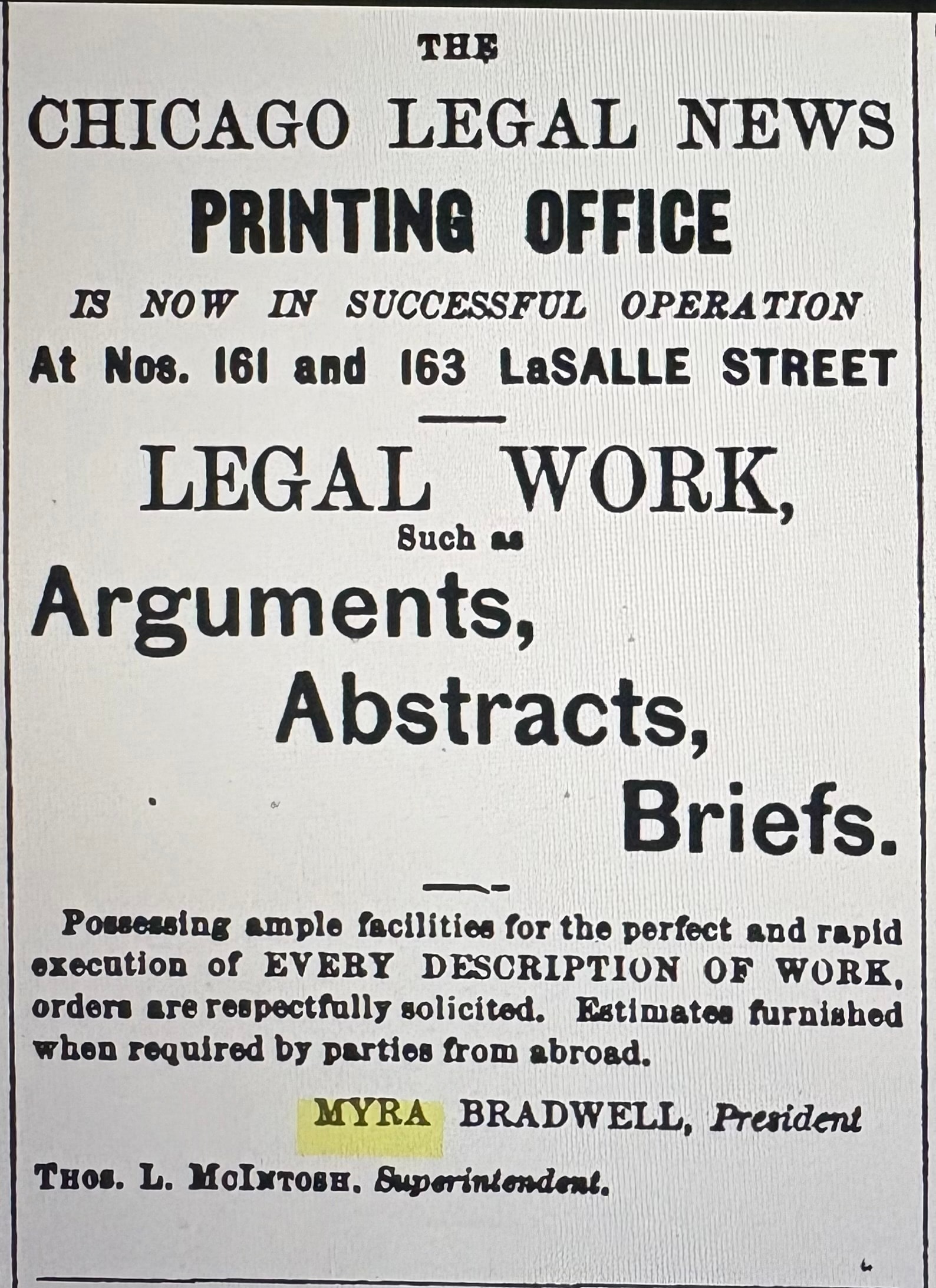
Document image for Advertisement: Chicago Legal News Printing Office, 161 and 163 LaSalle Street

Advertisement: Chicago Legal News Printing Office, 161 and 163 LaSalle Street

Date: January 11, 1873

Repository: Chicago Legal News, January 11, 1873

An advertisement published in the Chicago Legal News announced that the newspaper's printing office was operating at 161 and 163 LaSalle Street in Chicago, offering commercial printing services to the legal profession and other customers. The office specialized in printing legal arguments, abstracts, and briefs — documents essential to the practice of law. It also advertised its ability to handle other types of printing work, emphasizing its facilities, speed, and willingness to provide estimates to customers outside Chicago. At the bottom of the advertisement appeared two names: Myra Bradwell, President, and Thomas L. McIntosh, Superintendent. The advertisement offers a glimpse into Bradwell's role as a businesswoman. She was not merely the editor and publisher of a legal newspaper — she also headed a commercial printing operation that served the legal profession. The timing is significant: the advertisement appeared approximately fifteen months after the Great Chicago Fire of October 1871, which destroyed the newspaper's offices. By January 1873, the company was advertising an operating printing establishment at its LaSalle Street address. There is another striking contrast. At the time this advertisement appeared, Bradwell's challenge to her exclusion from the Illinois bar remained pending before the U.S. Supreme Court. Although she was prohibited from practicing law because she was a woman, she was already leading a business that produced the documents attorneys relied upon in their work.