
1831 – 1894
Myra Bradwell
Curator’s Note
Curator’s note: This transcription of Myra Bradwell’s obituary from the Chicago Legal News preserves the original language, including historical inaccuracies. For research and educational purposes, I recommend you check it against the included photographs of the original publication. I have inserted subheadings for ease of reading. I noticed that the obituary incorrectly dates the U.S. Supreme Court’s decision in Bradwell v. Illinois to May 1873; the decision was issued April 15, 1873.
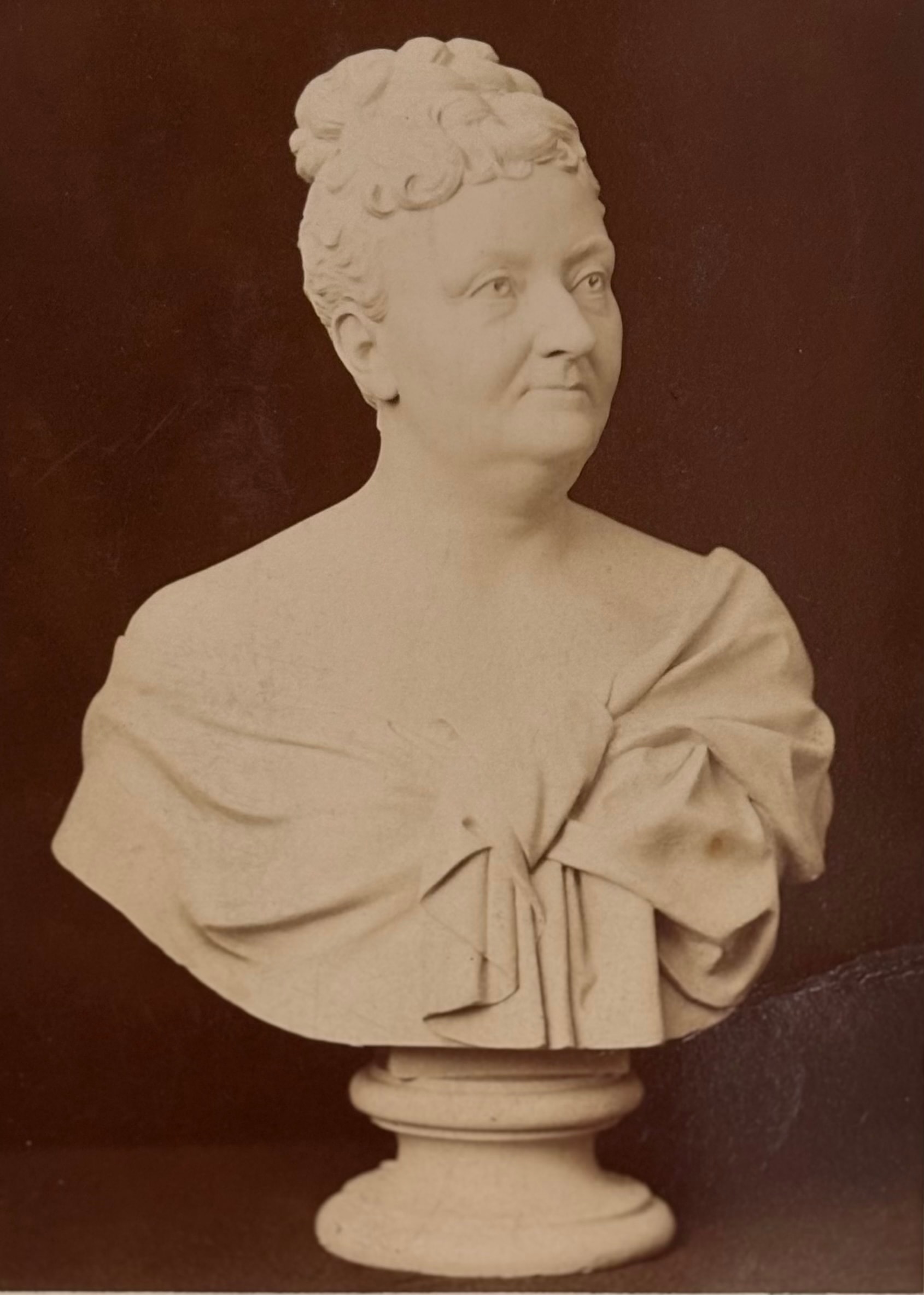
Obituary: Chicago Legal News, v. 26 1893/1894
MYRA BRADWELL.
Myra Bradwell, founder and editor of the Legal News, died at her home, 1428 Michigan avenue, at noon, February 14, 1894, after a long and painful illness.
Three years ago last January Mrs. Bradwell discovered that she was afflicted with the dread malady, cancer. From the first she felt that death was inevitable. A brave fight for life and health was made. All that medical science could do was done to save her life. The best physicians abroad and in this country were consulted, but their skill was unavailing. For three long weary years she was never free from pain; patiently and with Christian fortitude she endured her terrible sufferings. With indomitable courage and determination she declined until the very last to take opiates to alleviate her pain.
It was a keen disappointment to her to think that she could not see the World’s Fair, the achievement of the century, in which she had been so deeply interested. Contrary to the advice of her physician, Dr. J. Sidney Mitchell, and her friends, when she was hardly able to hold up her head, with that strong will which had carried her through so many difficult undertakings, she determined to see the World’s Fair. She was taken down to a hotel near the grounds and remained there for one week. Each day for an hour or two she was wheeled around in a chair. Pathetic indeed was it to see her, her fair face drawn with pain, and her beautiful brown eyes turned so wistfully, so sadly, upon the visions of the Dream City. The sixth of September she returned to her home, was helped from the carriage to her bed, from which she never again arose.
For the past four weeks her death has been daily expected by the attending physician, but so great were her will power and vitality, so wonderful her recuperative faculties, that her departure was stayed for a time. All day last Monday, her sixty-third birthday, her family watched by her bedside, expecting that every hour would be her last. It was a great comfort to her family and friends to know that under the skillful treatment of Dr. J. Sidney Mitchell, the last days of the gentle patient sufferer were comparatively free from pain. Death came to her painlessly and peacefully. Just before she died she revived from a partly unconscious state and, with a supreme effort, spoke the names of husband and children.
She was a firm believer in the Christian faith and died in the fullest hope of a blissful immortality. As she was murmuring the names of her loved ones, her daughter said, “Happy mother, will you watch and wait for us on the other side?” Faintly murmuring “Yes, yes, yes,” her soul passed to her Maker. The light of the household went out and her family were alone in the darkness of desolation.
Early Life & Marriage
Myra Bradwell, wife of Judge James B. Bradwell, of Chicago, was the daughter of Eben Colby and Abigail Willey Colby, formerly of Manchester, Vermont. She came from good colonial stock, numbering among her ancestors men prominent in the nation. Upon the maternal side she was a descendant of the Willeys, a family that was well represented in the American Revolution, two members of whom were in the battle of Bunker Hill. She was born in Manchester, Vermont, February 12, 1831, and in infancy was taken to Portage, New York, where she remained until about twelve years old. She then came west with her father’s family and first settled in the town of Schaumburg, in Cook County, but the greater part of her life was spent in Chicago.
Myra was educated at Kenosha and at the ladies’ seminary in Elgin, in which she afterward became a teacher. She was the first teacher in the district south of Plum Grove; taught school in Eudina, Kane County, at Flint Creek in Lake County, in Palatine, had in 1853 the largest select school in Memphis, and for a time was a teacher in the public schools of that city.
May 18, 1852, she was married to James B. Bradwell, whose parents were among the pioneer settlers of Illinois.
The Bar Admission Fight
When Mrs. Bradwell first began the study of law under the tutelage of her husband, she had no idea of becoming a practicing lawyer, but subsequently felt that she might be of valuable assistance to her husband in his business. She applied herself vigorously to her studies and passed a most creditable examination, but was denied admission by the Supreme Court of Illinois upon the ground that she was a married woman, her married state being considered a disability. Whereupon she filed an additional brief and with great force combated the position of the court.
In due time the court, by Chief Justice Lawrence, delivered an elaborate opinion in which it was said that, upon mature deliberation, the court had concluded to refuse to admit Mrs. Bradwell to the bar upon the sole ground that she was a woman.
She sued out a writ of error against the State of Illinois in the Supreme Court of the United States. Her case in that tribunal was argued in 1871 by Matt. Carpenter, United States Senator from Wisconsin. In May, 1873, the judgment of the Supreme Court of Illinois was affirmed by the U. S. Supreme Court, Mr. Justice Miller delivering the opinion of the court. Mr. Justice Bradley delivered a separate opinion, and Mr. Chief Justice Chase, true to his principles, delivered a dissenting opinion. Though this decision was adverse to Mrs. Bradwell, she never again renewed her application for admission to the bar, but was much surprised to receive a certificate of admission upon the original application and record from the very court that had refused her admission years before.
The American Law Review said, “her application was the first serious attempt by a woman to share the labors of the law since the fourteenth century.”
In 1870, sixty of the leading lawyers of Chicago petitioned Governor John M. Palmer, now Senator Palmer, to appoint Mrs. Bradwell notary public, but the governor did not consider he could then legally grant the prayer of the petition, because she was a married woman, and could not properly execute the bond required by the statute. The Governor, in his opinion, kindly said, “While I do not believe you are eligible to the appointment you seek, under the law, there is no one that I would more cheerfully appoint, if the matter were within the limits of my official discretion.”
The Chicago Legal News
The first weekly legal paper published in the Western States was the Chicago Legal News, established in 1868 by Myra Bradwell, who has always been its manager and editor. Believing fully in the power of the law, she adopted as the motto of the Legal News the words “Lex Vincit,” which have always been at the head of its columns. The Legislature gave her a special charter for the paper and passed several acts making it evidence in the courts, and a valid medium for the publication of legal notices. The law giving to married women their own earnings was drawn by Myra Bradwell, and its passage secured through her efforts in 1869; also the law giving to a widow her award in all cases. She was the only married woman that was ever given her own earnings by special act of the Legislature. She also obtained from the Legislature special acts making all the laws of Illinois, and the opinions of the Supreme Court of the State printed in her paper, evidence in the courts.
Mrs. Bradwell first commenced to edit and publish the Illinois session laws in 1869, and from that day to this she has always succeeded in getting her edition out many days before any other edition appeared. She has always, until prevented by her last illness, taken the printed copy of the laws to Springfield and compared it with the enrolled laws in the office of the Secretary of State, before publication. She has, commencing with the year 1877, every two years published an edition of Hurd’s Revised Statutes of Illinois, including the laws of the previous session of the Legislature. Mrs. Bradwell, since the law allowing women to vote for school officers was passed, has always voted whenever she had the opportunity. She prepared and published four volumes of the questions propounded and the answers of law students in examinations before the Supreme and Appellate Courts, which, by calling the attention of the bench and bar to the same, did much to add to the efficiency of such examinations throughout the State.
At the Chicago fire, in common with thousands of others, Mrs. Bradwell lost home and business possessions; but undismayed by misfortune, she stood cheery and indomitable, uttering brave prophecies of future good. As an evidence of her enterprise and energy, it is interesting to note that not an issue of her paper was lost; but hastening to Milwaukee, she had the paper printed and published on the regular publication day.
Public Service & Civic Life
Mrs. Bradwell was appointed by the Governor of Illinois a delegate to the Prison Reform Congress at St. Louis, and it was mainly by her efforts that women, after a severe contest, were allowed a representation on the list of officers; she declining to accept any office herself.
The Governor of Illinois appointed Mrs. Bradwell as one of the Illinois Centennial Association to represent Illinois in the Centennial Exhibition of 1876 at Philadelphia; and she was made treasurer of the Women’s Branch of the Association. After the Association had accomplished its work there remained in Mrs. Bradwell’s hands, as treasurer, several hundred dollars, which was transferred by a vote of the Association to the Illinois Industrial School for Girls. She was one of the founders and named in the charter as one of the corporators of the Illinois Industrial School for Girls at Evanston, for years a member of its executive committee and for fifteen years its treasurer.
Mrs. Bradwell circulated the call for the first great Woman’s Suffrage Convention in Chicago at Library Hall in February, 1869, and was one of its vice presidents. She obtained to the call the names of all the judges of the courts in Cook County, as well as many of the leading members of the bar, and ministers in the city. In her report of the meeting, she said: “During the two days’ session of the convention, Library Hall was packed to its uttermost capacity with the beauty and fashion of the city. Able lawyers, eloquent and distinguished divines, and gallant generals occupied seats upon the platform and took part in its deliberations.” She was one of the active workers in the Suffrage Convention held at Springfield in the winter of 1869, and for a number of years one of the executive committee of the Illinois Woman Suffrage Association. She also took part in the convention at Cleveland which formed the American Woman Suffrage Association.
During the war Mrs. Bradwell was active in receiving and caring for the sick and wounded soldiers. She was a member and secretary of the Committee on Arms, Trophies and Curiosities of the Great Northwestern Sanitary Fair, and was the leading spirit in producing that artistic and beautiful exhibition in Bryan Hall in 1865. The Voice of the Fair of June 9, 1865, in referring to what she had done in this department, said: “Mrs. Judge Bradwell, who long before this magnificent structure in which she presides was animated with its grandeur, was devoting all her wonderful energies to its complete success. Her attention to everybody and everything has been unceasing, and in the midst of a melange of questions which would have frenzied an ordinary person, her courtesy and kindness have maintained an equable glow. The flattering success of this department must, to a vast extent, be attributed to her connection with it.”
The Soldiers’ Fair of 1863 and the Fair of 1867, for the benefit of the families of soldiers, had no more active or efficient worker than Mrs. Bradwell. She was untiring in her efforts to get the World’s Fair at Chicago. She attended the meeting at Milwaukee, was a leader in getting up the meeting at Central Music Hall in the interest of locating the Fair here, was one of the original nine of the Woman’s Auxiliary of the Temporary Board, accompanied the commission to Washington, and rendered valuable services in securing the location of the Exposition in Chicago.
Mrs. Bradwell was appointed one of the Board of Lady Managers and was chairman of the Committee on Law Reform of its Auxiliary Congress. Mrs. Bradwell has made three trips to Europe, in 1879 for her health, in 1883 she made the pilgrimage with Apollo Commandery, and in 1891 for her health and to consult Sir Spencer Wells, of London.
Mrs. Bradwell was the first woman in the United States to apply for admission to the bar; the first woman who became a member of the Illinois Press Association; also the first woman who became a member of the Illinois State Bar Association; was a charter member and patroness of Miriam Family of the Eastern Star (Masonic), organized October 6, 1866, being the first body of that order in Illinois. She was one of the charter members of the Washingtonian Home, was a member of the Woman’s Club, the Daughters of the American Revolution, the Grand Army, the Woman’s Press Association, and the National Press League.
In 1871 she delivered the annual poem before the Illinois Press Association, entitled “Woman’s Rights.” She was vice president of the Association in 1872, 1874, 1875, and 1877; was a general attendant upon the meetings of the Association, and whenever business and health would allow, enjoyed going on its annual excursions.
Mrs. Bradwell delivered a paper upon “Civil Service Reform” before the Woman’s Club at the Auditorium Hall, on the afternoon of May 18, 1893, and was then so weak that she had to sit down before the reading was completed. This was the last paper ever delivered by her.
Family Life
Mrs. Bradwell had four children, two of whom went early to the rest beyond—James and Myra, a son and daughter. Thomas and Bessie are living, both married and both lawyers. The daughter is the wife of Mr. Frank A. Helmer, a lawyer of this city. Her son married Miss Hattie Barton, who was ever very dear and near to her mother’s heart.
Mrs. Bradwell used to laughingly refer to the fact that she must be a good mother-in-law since, on her trip to Europe for her health in 1891, she was accompanied by her devoted daughter-in-law and son-in-law. The presence of her grandson on this occasion gave her great satisfaction and pleasure. Mrs. Bradwell was devotedly attached to her two grand-children, James B. Bradwell, Jr., fifteen years of age, and Myra Bradwell Helmer, four years old.
When she first made the dreadful announcement of her incurable disease, she burst into tears and said, “I shall not live to see Baby Myra grow up and she will never remember me.”
In her declining days it was a great comfort to her to think she had been spared until little Myra was old enough to remember her grandmother.
She also left three sisters, Mrs. Rachel Goodno, wife of Rev. Goodno, of Asbury, New Jersey, Mrs. Lucy Waldo of Holdrege, Nebraska, and Mrs. Mary Haviland of Fort Dodge, Iowa.
Character & Legacy
Mrs. Bradwell was one of those who live their creed instead of preaching it. She did not spend her days proclaiming on the rostrum the rights of women, but quietly, none the less effectively, she set to work to remove the legal disabilities under which women labored. A pioneer in opening the legal profession for women, with keen foresight she saw that the stepping stone to the emancipation of her sex was to secure the property rights of women. A case pointing so monstrously to the injustice of the law gave an added impetus to her zeal. A drunkard, who owed a saloon-keeper for his whisky, had a wife who had earned her own living as a scrubwoman, and the saloon-keeper garnished the people who owed her and levied on her earnings to pay her husband’s liquor bill. It needed but an application like this for her to succeed in her efforts to pass the bill
efforts to pass the bill which she drafted, giving the married woman the right to her own earnings.
Though active throughout her busy and useful life in philanthropic and charitable work, Myra Bradwell’s signal service to humanity was rendered in employing her legal talents for the relief and elevation of her sex. The generation coming after her will profit by her enlightened labors. She presents an ideal picture of what we hope the woman of the twentieth century will be, the woman of affairs, deeply interested and active in matters of public importance, and no less the true wife and mother.
The description of Myra Bradwell written some years ago in the Chicago Evening Journal aptly describes her characteristics:
“Mrs. Bradwell is a woman of far more than ordinary genius. As a writer she is ready, keen, sensible, and forcible. As a conversationalist she has few equals and no superiors among her sex. She never speaks without saying something worth hearing. She has plenty of excellent ideas and is never at a loss for the most appropriate language in which to clothe them. She is brilliant, witty, earnest, and often intellectually fascinating. She keeps well posted on all current topics of the day, and presents her opinions thereon in such an entertaining manner, and mingles dry facts with a statement of so much of refined sarcasm, womanly wit, and sound common sense, that listeners are sure to find themselves charmed if not convinced. Added to these qualities, Mrs. Bradwell is proverbial for her quiet, modest demeanor, and for possessing in an eminent degree those qualities of mind and heart which mark the true lady everywhere. She is one of the few who know when to remain silent, as well as when to speak, and what to say, and to this rare talent, as well as to her positive qualities, may be attributed her wide popularity. She has few, if any, enemies, while no woman in America, so far as her circle of acquaintances reaches, is blessed with more or warmer friends.”
In the early days of the woman’s rights movement, when the shafts of ridicule were hurled at all who were working for the emancipation of woman, Mrs. Bradwell was roundly abused for daring to believe it appropriate for a married woman to practice law. But no one who ever knew Mrs. Bradwell ridiculed her. So sweet, so gentle a soul, with such a charming personality, such a quiet, unobtrusive, courteous manner, such exquisite tact, could not fail to win and turn a detractor into an admirer. Like the lamented Lucy Stone, mild but firm, Myra Bradwell was a rare combination of sweetness and strength, of a daring, progressive nature which scorned to be hampered by the prevalent narrow notion of woman’s sphere. Firm in her convictions, and tenacious of purpose, she never lost an opportunity to work for the cause which was so dear to her heart. Never antagonistic or aggressive, many were the converts she made by her gentleness and grace. Of this, General Mason Brayman bears interesting testimony:
“During the first half of my life I was not in favor of the intrusion of women in the fields of usefulness appropriated by custom and consent to men. Had I been on the bench when Mrs. Myra Bradwell applied for admission to the bar, I should have decided with the majority. Some twenty years ago I made Mrs. Bradwell’s acquaintance, and during the first half hour I spent with her I began to change my opinion in regard to the enfranchisement of women. I began then to understand that masterful business ability, energy, and knowledge of the abstruse were quite consistent with the grace of manner which adorn the home, the modest demeanor, the voice ever soft, gentle and low, an excellent thing in woman. Previous to my acquaintance with Mrs. Bradwell I had associated women in public life with some public scolds I know.”
She did not preach sisterhood; she acted sisterhood. Deeply sympathetic by nature, she ever esteemed it a pleasure as well as a duty to lend a helping hand to the poor. Believing that true charity consists in helping others to help themselves, she spent much time and strength in securing employment and positions for the many women who applied to her. But it was not alone the unemployed to whom she rendered services. Many were the women who found in her counselor, an inspiration, a mentor.
During her last days, when some of those who used to come to her for consolation and comfort called, her daughter tried to persuade her not to see them, saying, “You are too ill to hear about their burdens and sorrows.” “Oh, no, let them come. Let me do all the good I can while I stay.”
She was essentially and thoroughly domestic in her tastes. Her home was her heaven. Her husband and her children were the idols of her heart. A touching incident of her last days was when she gave to her husband a book with the injunction to read it when she was gone. He found inscribed in the dear familiar handwriting, a poem written in commemoration of their life and love.
During all her daughter’s college course, amidst the daily press of business and home cares, the daily “mother’s letter” never failed to bear a loving message to her absent girl. Earnest, tender, and womanly, full of that poetic inspiration which is so commonly but mistakenly considered the exclusive prerogative of youth, she lived a beautiful life and never grew old. Death came to her just when she was beginning to see the fruition of her life work, the dawn of the better day for woman—for humanity.
Funeral Services
The funeral services were held at her residence, 1428 Michigan Avenue.
The honorary pallbearers were: Judge H. W. Blodgett, Judge H. M. Shepard, Dr. Delaskie Miller, Hon. T. B. Bryan, Gen. J. Corson Smith, C. C. Bonney, H. W. Bishop, and J. W. Butler.
The active pallbearers were: Hon. E. B. Sherman, Judge E. A. Otis, George W. Cass, E. F. Runyan, Wallace Heckman, and J. R. Mann.
Funeral by carriages to special train, leaving Wells Street Depot on C. & N. W. railroad for Rosehill Cemetery at 2:30 P. M.
Music was furnished by the Plymouth Church Quartet Choir.
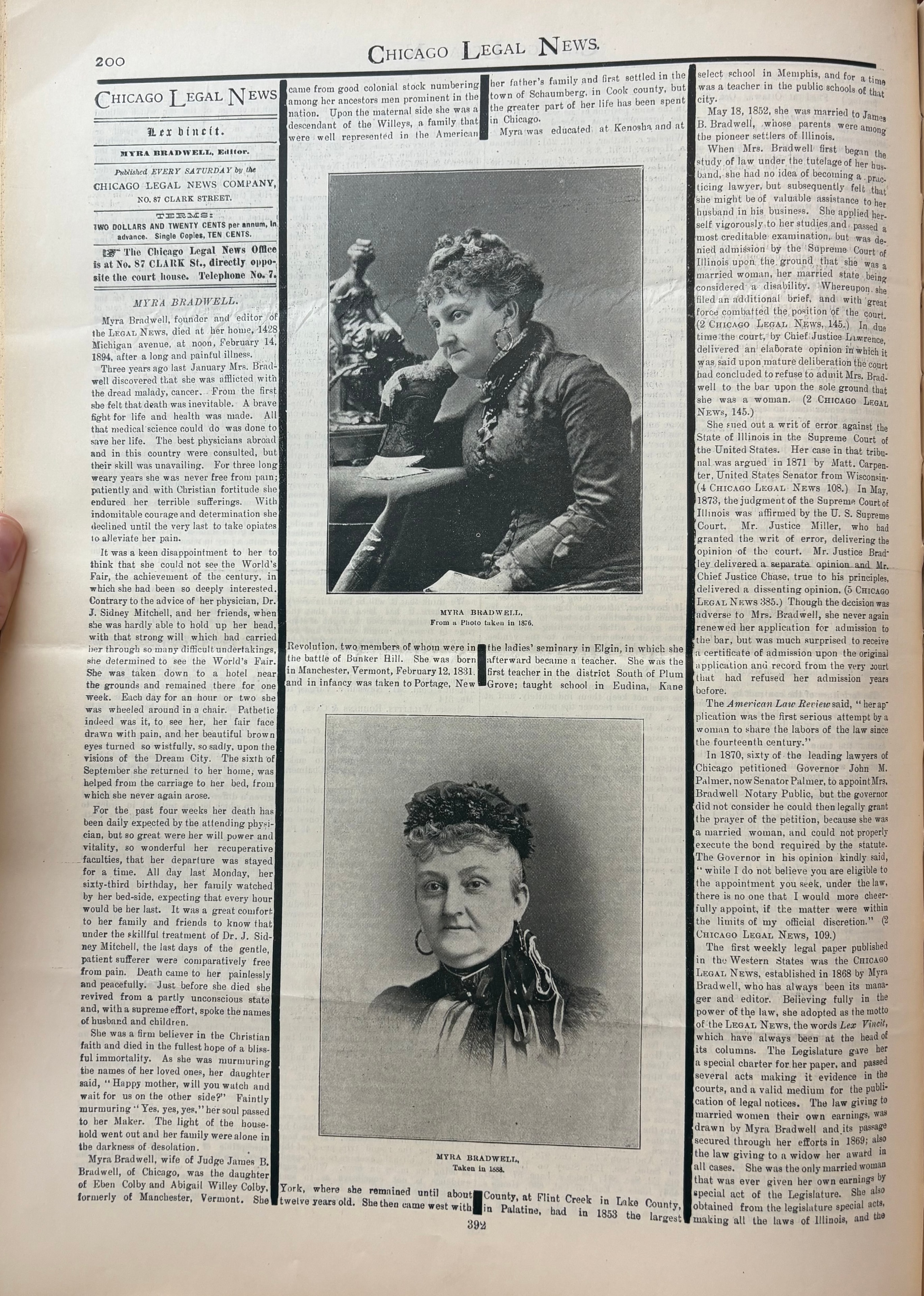
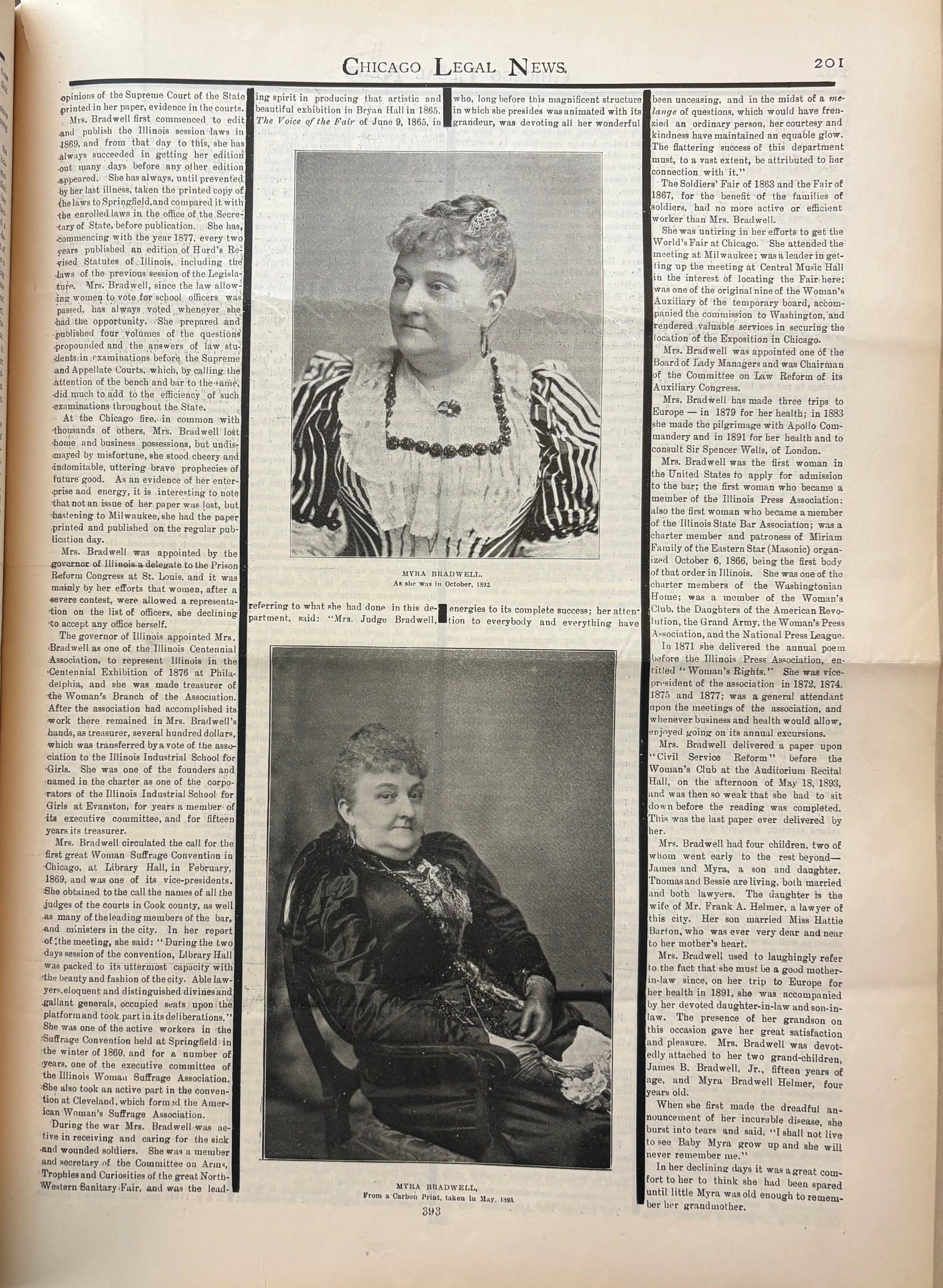
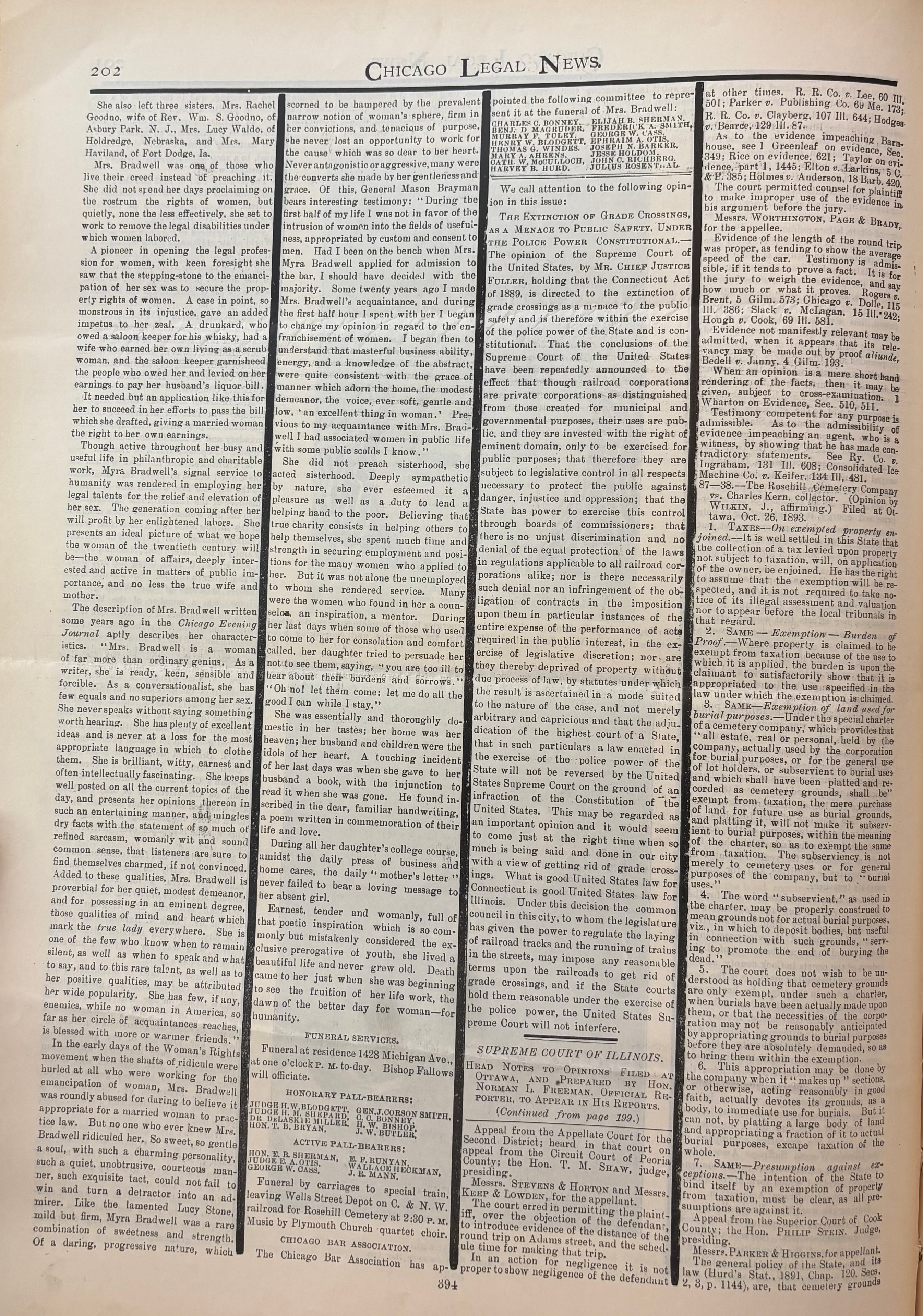
The obituary images are reproduced from archival copies of the Chicago Legal News photographed by Stephanie Hoops at the Chicago History Museum.